Every engineering leader has said it at some point: “We need to be more high-performing.”
The problem is, most organisations then go looking for a process to make that happen. They adopt a new Agile flavour. They buy another tool. They bring in a consultant who delivers a report, waves goodbye, and leaves behind a 40-slide deck that nobody reads past page 12.
The team doesn’t change. The culture doesn’t shift. And six months later, the same bottlenecks exist - they just have better Jira labels.
High-performance isn’t a process. It’s a culture. And culture has ingredients.
Why Engineering Teams Stagnate
The most common failure mode I see when working with scaling engineering teams isn’t technical. It’s motivational. Developers are smart people. They know when they’re being given work without context, when their decisions are being overridden without explanation, and when the environment punishes mistakes rather than learns from them.
The result is predictable: slower delivery, rising turnover, and a codebase that reflects a team that stopped caring - because the organisation stopped making it worth caring.
Retention is where this hits hardest. Losing a senior engineer doesn’t just cost you a salary. It costs you the institutional knowledge of your product, your architecture, your customers. You cannot buy that back. You can spend six months recruiting, three more onboarding, and still be twelve months behind where you were when they left. Research consistently shows that replacing an engineer costs between six to nine months of their salary in recruitment and onboarding alone - and for senior roles, Gallup puts the true cost as high as 200% of annual salary when lost productivity and institutional knowledge are factored in. [1][2]
The answer isn’t better recruitment. It’s building an environment people don’t want to leave.
Introducing the #beP.A.R.T. Framework
The #beP.A.R.T. framework emerged from working directly inside engineering teams - not from the outside, advising at arm’s length, but embedded within the culture, watching what actually drives performance versus what merely looks like it does.
It is not a rigid methodology. It won’t replace your sprint ceremonies or your deployment pipeline. It is a set of four cultural qualities - Proactive, Ambitious, Reliable, Team-player - that, when present together, allow engineering teams to scale without sacrificing quality, speed, or the people who make both possible.
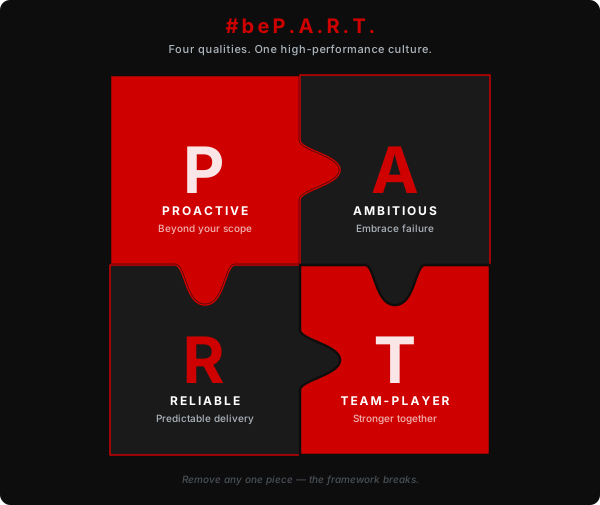
That last phrase matters: when present together. Each quality is genuinely valuable. Each is also, in isolation, capable of making things worse. The framework only works as a whole - and understanding why each pillar needs the others is as important as understanding what each one means.
P - Proactive
High-performing engineers don’t wait to be told where the problems are. They go looking for them - and not just within the boundaries of their own work.
Proactive means continuously seeking improvement across the wider system: flagging risks in adjacent services, proposing better ways to work before friction becomes a crisis, and bringing ideas to the table without being asked. It is the difference between an engineer who ships the ticket and one who asks whether the ticket is solving the right problem.
This quality doesn’t develop in isolation. It requires an environment where speaking up is welcomed and where cross-team visibility is the norm rather than the exception. Leaders who reward proactive behaviour create teams that stay ahead of problems rather than constantly reacting to them.
On its own, proactivity becomes noise. An engineer who is always identifying problems but never reliably closing them out creates a culture of perpetual motion - lots of initiatives, little delivery. Proactivity earns its value when it is anchored by reliability.
A - Ambitious
Ambition in an engineering team isn’t about velocity at all costs. It’s about the willingness to tackle hard problems, take calculated risks, and treat failure as information rather than a verdict.
Ambitious engineers are not afraid to fail. They propose bold technical solutions, push for higher quality standards, and are eager to grow beyond where they are today. They don’t default to the safe option because it is comfortable - they ask what the best solution actually looks like, and then try to build it.
Daniel Pink’s research on intrinsic motivation identifies autonomy, mastery, and purpose as the three drivers that sustain high performance for complex, creative work - and ambition is the engine that converts those conditions into output. [3] Where extrinsic incentives (bonuses, fear, deadlines) erode creativity over time, an environment that allows engineers to pursue mastery and grow in their craft produces durable, compounding performance.
On its own, ambition is dangerous. An ambitious engineer without the team-player instinct becomes a lone wolf - making bold architectural decisions without buy-in, accumulating personal knowledge that never transfers, and leaving a codebase that only they fully understand. High ceiling, catastrophic floor.
R - Reliable
Reliability is the foundation that allows everything else to function.
A reliable engineer works with predictable performance and a clear commitment to the collectively agreed plan. Deadlines are communicated honestly. Estimates are realistic. When something changes, the team knows early - not the day a deadline is missed. This consistency is what allows teams to plan, to delegate, and to build on each other’s work with confidence.
Reliability isn’t about never getting things wrong. It’s about being dependable enough that the team can make decisions around you. High-performing teams are built on the aggregate trust that comes from everyone doing what they said they would do - consistently, over time. Google’s Project Aristotle identified dependability as the second most critical factor in team effectiveness, sitting just behind psychological safety. [4]
On its own, reliability becomes stagnation. A team of highly reliable engineers who never challenge the status quo will deliver predictably mediocre results. They will hit every sprint target and ship nothing remarkable. Reliability without ambition is a sophisticated way of standing still.
T - Team-Player
Engineering is a team sport, and the best engineers know it.
A team-player actively recognises the benefits of collaboration - not as a soft skill footnote, but as a core professional value. They share knowledge freely, support colleagues through difficult problems, and understand that the output of the team matters more than the brilliance of any single individual.
This shows up in the everyday details: thorough code reviews, clear documentation, honest retrospectives, and a willingness to slow down on one’s own work to unblock someone else. Teams where this is the norm move faster collectively, because no one is hoarding knowledge or operating in silos.
On its own, team-player culture becomes groupthink. A team that values harmony above all else stops challenging ideas, stops pushing for better, and starts optimising for consensus rather than quality. Amy Edmondson’s research on psychological safety makes a critical distinction here: safety enables candour, not comfort. [5] A genuinely collaborative team is one where people feel safe enough to disagree - not one where disagreement has been quietly retired.
Why the Four Must Work Together
This is the part most frameworks miss.
Each of these qualities sounds unambiguously positive in isolation. In practice, each one contains a failure mode that one of the other three directly corrects:
- Proactive engineers need Reliability to be trusted. Ideas carry weight when the person proposing them also consistently delivers.
- Ambitious engineers need Team-player instincts to be sustainable. Bold decisions made without collective buy-in create brittle systems and resentment.
- Reliable engineers need Ambition to avoid plateauing. Predictability without growth is a polished form of stagnation.
- Team-player engineers need Proactivity to remain a performance driver. Collaboration without initiative is harmony, not progress.
The framework functions as a system of mutual constraints. Remove any one element and the remaining three will, over time, drift toward their failure modes. This is why culture-building is harder than process implementation - you cannot install one ingredient and declare the work done.
Why Process Alone Never Works
What the #beP.A.R.T. framework ultimately resists is the temptation to solve human problems with structural ones. We’ve all seen it: a company adopts a rigid “Agile” framework and suddenly, engineers spend more time in Jira than in their IDEs.
You cannot fix a culture of disengagement with a new sprint cadence. You cannot build psychological safety with a retrospective template.
The four qualities - Proactive, Ambitious, Reliable, Team-player - are relational. They require consistent, intentional behaviour from leadership at every level. They require someone inside the organisation who understands both the technical and the human dynamics at play. That is exactly where a Fractional CTO earns their value - not just as an architect, but as a culture-builder who can identify the subtle friction points that slow down innovation.
The Retention Effect
There is a compounding benefit to getting this right that is easy to underestimate.
Teams built on the #beP.A.R.T. principles retain people - not because of perks or compensation packages, but because the environment itself is one that talented engineers actively seek out. Ambitious engineers stay where they are allowed to grow and take risks. Proactive ones stay where speaking up leads to change. Reliable ones stay where their dependability is recognised rather than taken for granted. Team-players stay where collaboration is the norm, not the exception.
Tenure builds institutional knowledge that cannot be replicated by onboarding new hires. And as Google’s Project Aristotle found, individuals on teams with a strong culture are less likely to leave, more likely to harness diverse ideas, and rated as effective twice as often by senior leadership. [4]
The organisations that build high-performance engineering teams worth being part of don’t do it by optimising for short-term output. They do it by creating conditions where talented people grow, make consequential decisions, depend on each other, and stay.
The returns compound. And unlike technical debt, the interest works in your favour.
Building for the Long Haul
True high-performance avoids burnout cycles. A team that delivers at 100% for one month and collapses the next is not a high-performance team. Consistent, quality output emerges when the culture prioritises the human elements that sustain it.
High-performance engineering isn’t a destination you arrive at once. It is a culture you actively maintain - one that requires the same attention, investment, and honesty as your product itself.
Don’t just manage. Be part and build.
References
- SHRM - Essential Elements of Employee Retention: replacing an employee typically costs six to nine months of their salary, covering recruitment, interviewing, and onboarding.
- Gallup - This Fixable Problem Costs U.S. Businesses $1 Trillion: the cost of replacing an individual employee ranges from 50% to 200% of their annual salary, depending on seniority.
- Daniel Pink - Drive: The Surprising Truth About What Motivates Us (2009): drawing on four decades of behavioural science research, Pink argues that autonomy, mastery, and purpose - not external rewards - are the primary drivers of high performance for complex, creative work.
- Google re:Work - Understand Team Effectiveness (Project Aristotle): a multi-year study of 180+ Google teams found psychological safety to be the single strongest predictor of team effectiveness, followed by dependability, structure, meaning, and impact.
- Amy Edmondson - Psychological Safety and Learning Behavior in Work Teams, Administrative Science Quarterly (1999): the foundational study establishing that team psychological safety - the shared belief that the team is safe for interpersonal risk-taking - is the key enabler of learning behaviour and team performance.