Most of what I publish here is advice for other people’s technology decisions. This piece is different: it is a case study of my own product, Nothing Unlucky, a coaching platform for grassroots football that Egon Expert Ltd publishes and runs. I am writing it up because the decisions that shaped it are the same ones I get hired to make for clients, at a price point that forgives nothing.
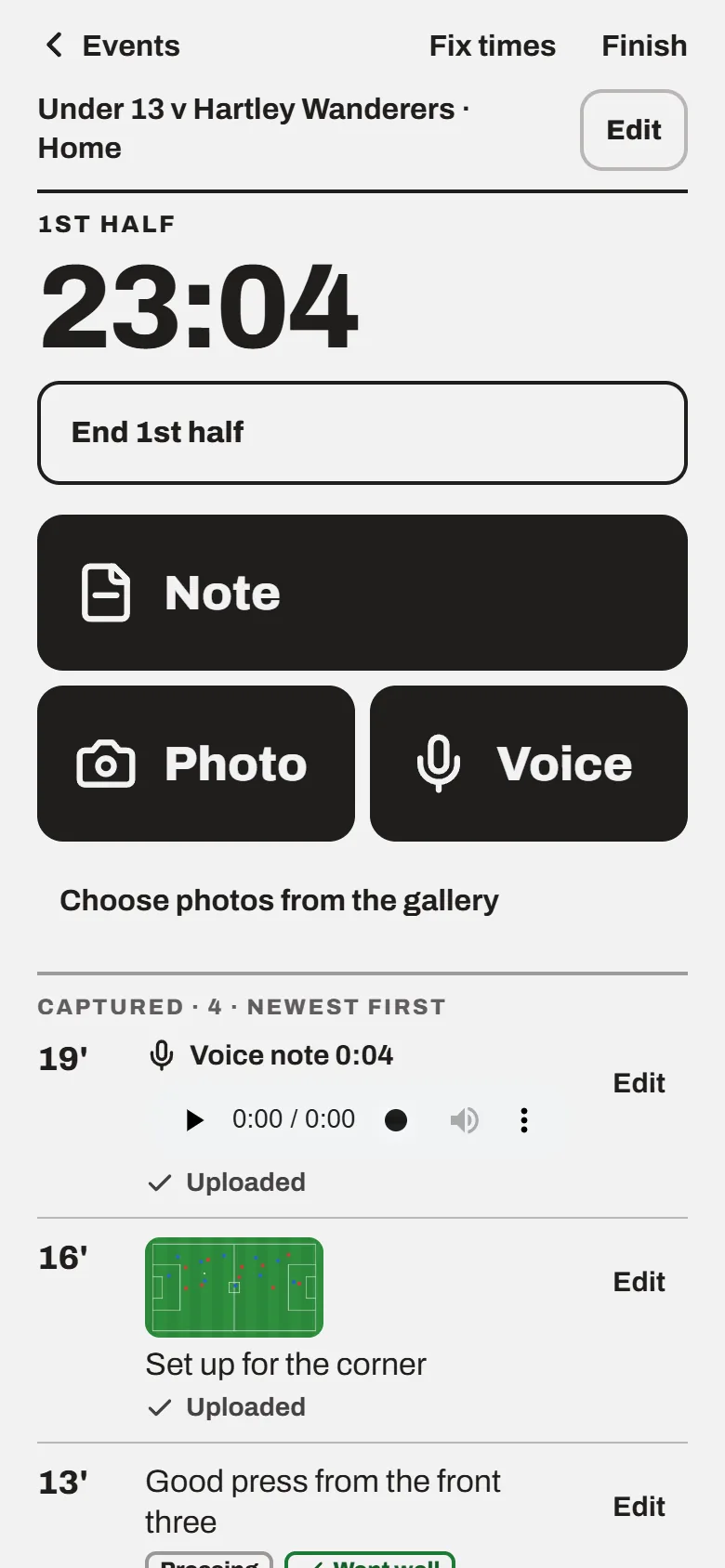
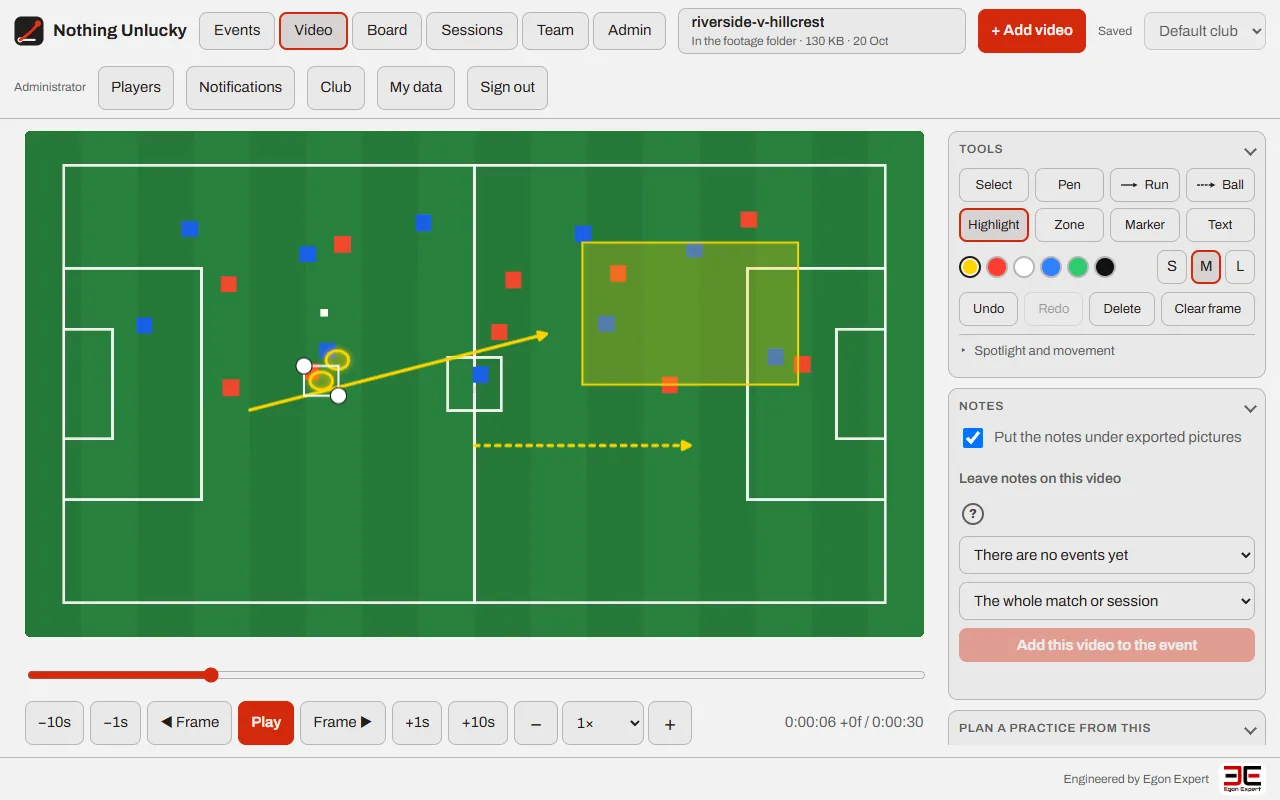
Nothing Unlucky is an assistant coach. At the pitch side a coach captures notes, photos and voice notes against the match clock on a phone. Afterwards the video goes in, the notes line up along its scrubber, and the coach can mark a moment, draw on it, cut a clip, plan the next training session from it and show each player the moments that belong to them. A tactics board, a session planner and AI match summaries round it out. One record, phone and computer both writing to it.
The customer is a volunteer coach or a small club. The price is £4.99 a seat a month, or £49.99 for twelve months, where a seat is one coach on one team and players are free. Once VAT comes off, a monthly seat brings in about £4.16 before card fees, and that figure decided more of the architecture than any technology preference did.
The constraints did the designing
Four constraints shaped every decision that follows.
The price ceiling. At under £5 a month, any feature with a meaningful per-use cost is dead on arrival. Every running cost has to be measured in pence before it ships.
The touchline. Grassroots pitches have mud, rain and no signal. If capture depends on the network, the product fails at the exact moment it is supposed to be useful.
The data. The users coach children. Names, photographs and match footage of under-18s run through everything, so safeguarding had to shape the architecture from the first table.
One developer. The whole platform is built and run by one person, so the technology is deliberately boring: Go on the backend, TypeScript on the front (Vite, with Konva doing the drawing tools), Postgres underneath, Docker around it, every repeatable command behind a single task runner.
None of these constraints is exotic. What I see in client work is teams with plenty of constraints who still make decisions as though they had none.
Do the video arithmetic before choosing a vendor
Video is where the money goes. The platform runs on rented servers in the UK and the EU, which also hold the footage, and the heavy interactive work - reviewing frame by frame, drawing, cutting clips - is designed for a tablet or a computer rather than the phone at the touchline.
The arithmetic behind the video design is worth showing. A 90-minute match filmed in 4K is roughly 30 GB. When I priced conversion in October, a per-minute encoding vendor wanted around £1 per match at list rates, while the same job on compute rented by the hour came to between 7p and 29p - a gap of four to fifteen times. Hosted video platforms that encode for free charge for storage per minute, which priced out the storage add-on packs the plans depend on. Running the maths across providers moved the break-even for the business by anything from 6% to more than double, for the same feature.
So the design is: review happens only on a converted 1080p file (2 to 4.5 GB rather than 30), conversion sits behind a seam that starts with ffmpeg on a single machine and can grow into rented workers, and footage lives in plain object storage with an allowance, a meter and add-on packs. A club sees its video allowance in the app and can buy more, which makes storage something the customer chooses rather than a cost I discover on an invoice.
I would make the same recommendation to a client, and often do: before choosing a vendor, do the arithmetic per unit of real usage and let it tell you which costs belong on your side of the line. The same exercise for AI tools is in what AI actually costs a small business.
Offline-first, honestly
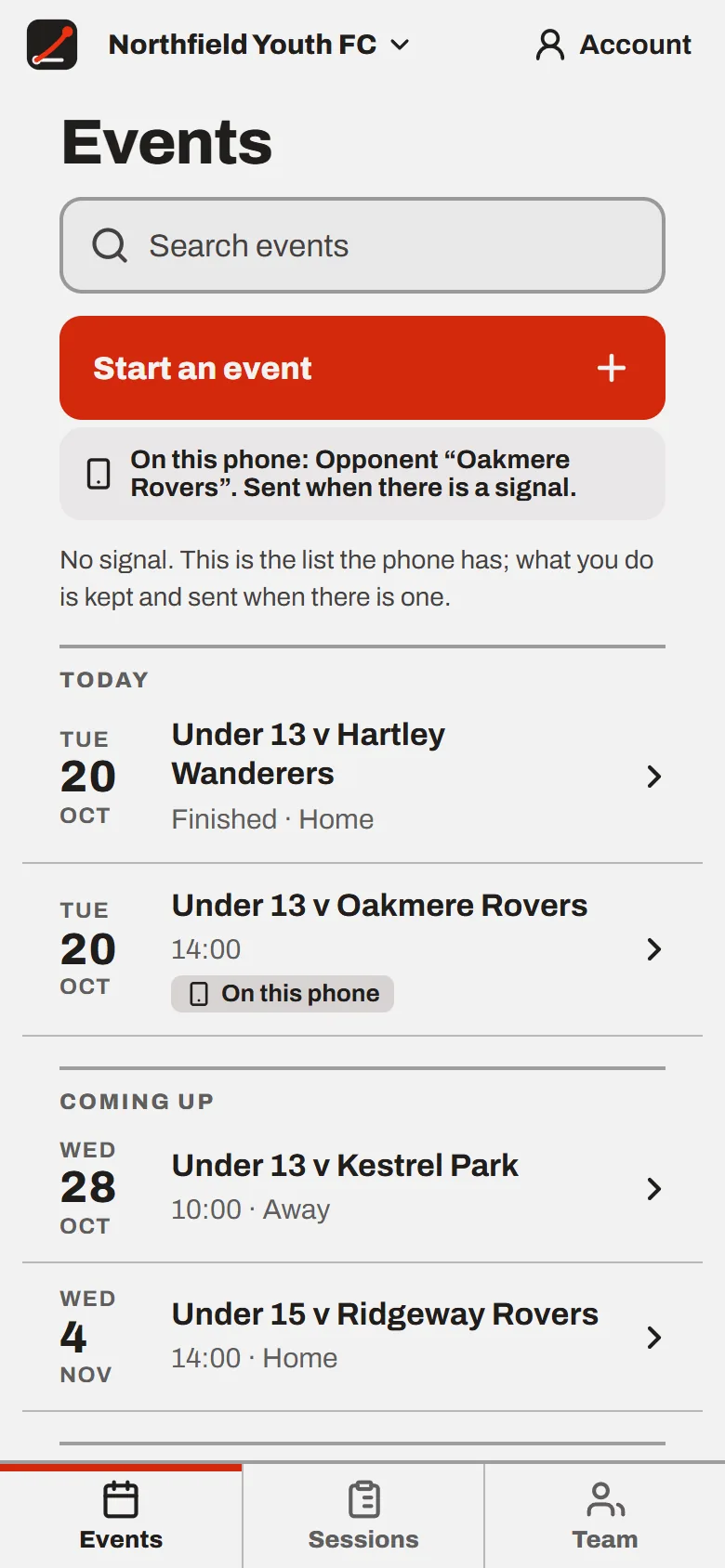
Everything a coach does on the phone is written to the phone’s own storage first and sent when there is signal; nothing waits on the network, and the phone keeps trying until it gets through. The app itself opens with no signal once it has been opened with one - a service worker keeps the application files and nothing else. Updates are handled with the same care: a deployed new version arrives on the next open, and an app already running shows a quiet “a new version is ready” bar rather than reloading itself, because nothing is allowed to interrupt live capture.
Offline-first is easy to claim. Built properly, it is a long list of small decisions about what happens when the network comes back, and it only works if it is there from the start.
AI where it earns its keep
The platform has AI in it, and the discipline applied to it is the part most worth reading. Before building anything I wrote an options paper with a cost and a verdict per feature - the same exercise I run for clients in an AI adoption engagement - and one rule fell out of it: use AI where the platform already holds the coach’s own words and plans, and keep it away from the video.
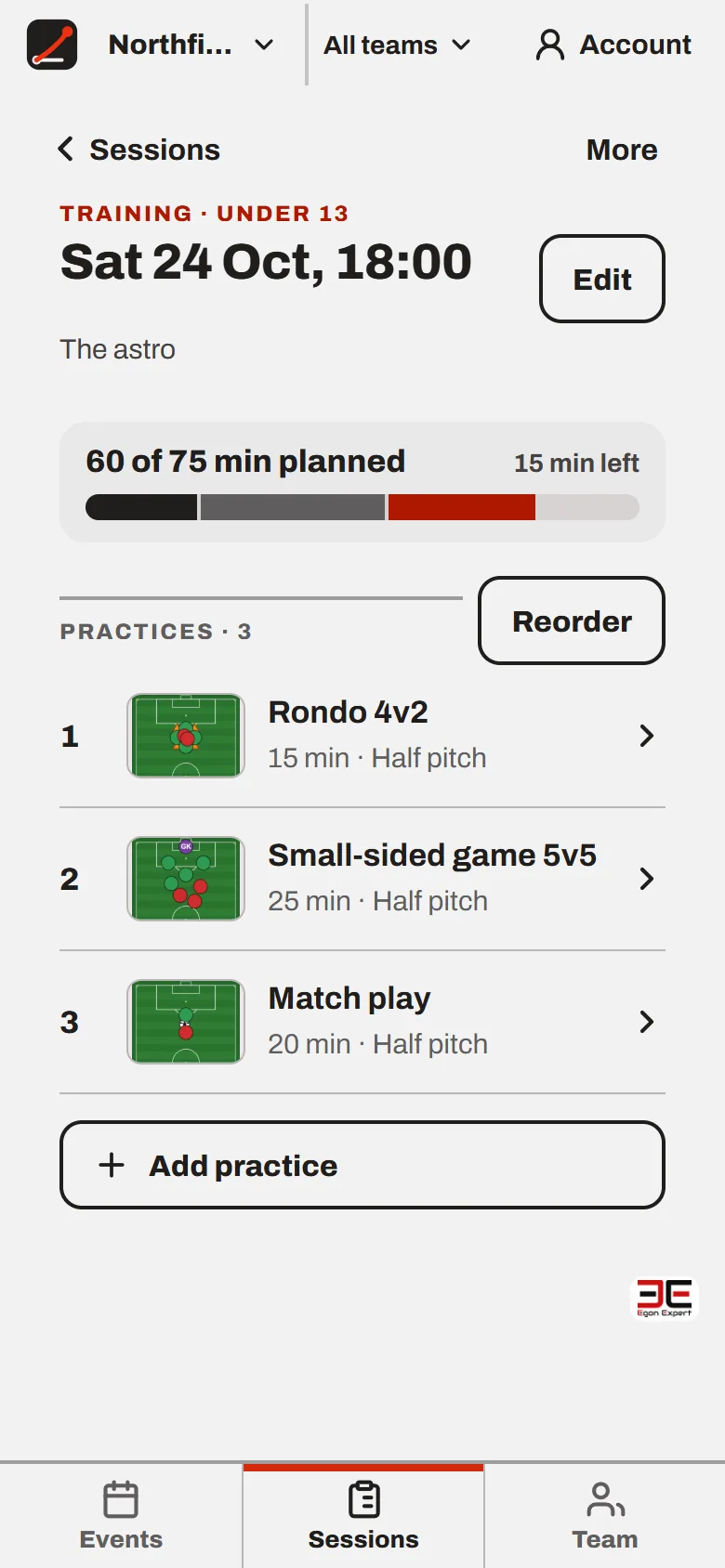
The features that pass the test are text features. Drafting a session sheet from a practice the coach has already built. Suggesting progressions. Above all, planning the next session from the last match: the platform holds the match notes and the drill library in one place, so it can turn Saturday’s problems into Tuesday’s training. I have not found a competitor that holds both halves of that loop.
Each of those costs one to three pence per use against a seat that brings in about £4.16 a month, so each plan carries a monthly allowance with a visible meter. The cost control was in the design before the first invoice arrived.
Every output follows the same rule as my client platforms: the AI proposes, the coach corrects. Drafts land in editable boxes, sessions are assembled from the curated drill library, and nothing is saved as final without the coach touching it. The honest claim is time saved and a better first draft. Better coaching is still the coach’s job.
The AI we refused to build
The more valuable half of the options paper is what it ruled out.
Whole-match video analysis - automatic event tagging, player tracking, heatmaps - is the feature everyone asks about and the one I declined to build. Veo already detects goals, shots, corners and free kicks automatically, and its cameras are in use in more than 100 countries; building a worse version over several months is not a reason for anyone to buy. Sending sampled frames to a vision model instead would cost dollars per match against a seat that brings in pounds per month, and the models’ own documentation is clear that counting and positions are approximate. A club can link its Veo footage instead of uploading it, and the effort goes where the data is unique: the coach’s own notes.
A narrower idea - freeze a frame, click “analyse” - got taken seriously and then bounded. It breaks into three problems: detecting the players (solvable with a purpose-built detector), judging positions (only honest if code does the measuring and the language model only words the result) and matching what it sees to training drills (the easy, valuable part, which needs no computer vision at all). So the version without vision ships first: the coach places players on the tactics board and asks for the analysis. The detector waits for a two-day spike on real frames to earn its place.
One finding from that exercise applies to every client who asks about computer vision: check the licences before you write a line. Ultralytics YOLO, the detector most tutorials start from, is licensed under AGPL-3.0, which for a commercial hosted product means buying an enterprise licence or releasing your own source. YOLOX is under Apache-2.0, which carries no such condition. Open-source licensing is one of the areas a technical due diligence reviews, and here it took an afternoon to check rather than a lawsuit to find out.
Safeguarding from the first table
The platform’s users film children, so the rules about where data may go are built in. AI features are off by default for every club, behind a switch, a usage limit and a log that records counts, never content. When a coach asks for a summary, the names on the club’s roster are replaced with labels such as “Player 12” before the text leaves the platform. Translation, also off by default, sends a note as the coach wrote it, and the privacy notice says so plainly. No audio, photos or video go to an outside AI service at all: voice notes are turned into words on the platform’s own server, and the player detector, if it earns its place, is designed to run there too and pass on anonymous coordinates rather than pictures.
The external bar is set by The FA’s guidance on photographing and filming children and the ICO’s Children’s Code. It is the discipline UK GDPR asks of anyone handling children’s data, applied at the scale of a Sunday league, and the same questions I put to businesses in is your company data safe in AI tools.
The boring commercial plumbing
The platform sells per-seat licences through Stripe, with the VAT wording, the terms and the behaviour of a lapsed plan specified and coded rather than improvised: a club whose payment fails keeps working for seven days and is then locked, and everything comes back if the plan is paid within 60 days. Nothing AI-related is charged for until a pilot with real coaches has logged whether drafts are kept, edited or discarded - a four-week test with a clear go or stop, because a feature coaches rewrite every time costs money without saving them any time.
What this buys a client
The platform is the example, not the point. The discipline is identical at £4.99 a seat and at a £2m departmental budget: do the unit economics before the feature, put human approval wherever judgement lives, and turn down the impressive feature that does not pay for itself.
If you want that discipline applied to your own technology decisions, book a free 30-minute consultation. Straight conversation, no commitment.